
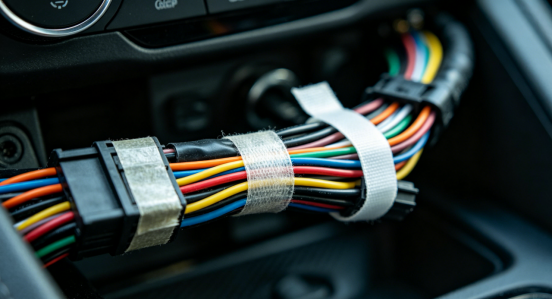
When people look at cars, the first things they usually notice are the exterior, the screens, or the horsepower. Very few pay attention to that bundle of ‘messy wires’ hidden under the door panels, chassis, and hood—that’s the car wiring harness. But you might not realize just how important it is: it’s like the car’s nerves and blood vessels, carrying electricity and signals. Whether the headlights light up, the doors close properly, or the driver-assist system works, all depends on it.
Today, let’s break it down in plain language: how is this wiring harness actually made? Why is it so expensive? And how do carmakers save money on it?
1. First, understand: what exactly is a ‘wiring harness’?
Simply put, a wiring harness is a bundle of a few to hundreds or even thousands of wires tied together, with connectors and protective sleeves, supplying power and transmitting signals to all the electrical devices in a car. A typical gasoline car has more than 1,500 wires in its harness.
New energy vehicles are even crazier, sometimes exceeding 5,000 wires. The prices vary a lot too: for a gasoline car around 100,000 yuan, a set of wiring harnesses costs 1,500-2,000 yuan; for a 300,000 yuan new energy car, it jumps to 3,000-6,000 yuan, and for luxury cars at the million-yuan level, it can even exceed 8,000 yuan. Definitely a ‘hidden champion’ in the supply chain.
2. How hard is it to make a wiring harness? Ten times more precise than you think
Many people think making a wiring harness is just ‘connecting wires,’ but that’s totally different. A qualified harness goes through more than a dozen processes, and every step must adhere strictly to standards.
Material check first: wires, connectors, plastic sleeves, tape… dozens of materials enter the factory, and each one must be inspected. Are the wires thick enough? Are the connector coatings secure? Can the plastic sleeves resist fire? If any single part fails, the whole batch is unusable.
Cutting and stripping wire insulation: rolls of wire are cut to the required length, and the ends are stripped to expose copper. Machine precision can control this to ±0.5mm. That might not sound like much, but if it’s just 1mm short, the wire is scrap.
Crimping connectors: stripped wires and connectors are tightly ‘bitten’ together under pressure, and the pull-out strength must meet standards—like a 0.5mm² wire must withstand at least 50 newtons of force without slipping. After crimping, it’s examined under a microscope to check for bad contacts or broken strands. Otherwise, lights could flicker or signals could break while driving, creating safety hazards.
Assemble ‘small components’ first: complex harnesses can’t be made all at once. They’re split into ‘sub-assemblies’ like doors or dashboards for separate assembly. This step is mainly done by hand, as machines can’t fully replace workers yet.
Final assembly and bundling: all the ‘sub-assemblies’ are put together into the full harness and securely wrapped with tape or corrugated tubes. Different locations use different materials: ordinary areas can use normal tape, but in the engine bay, where temperatures are high, heat-resistant silicone sleeves above 200°C are needed, or they’ll melt over time.
Final ‘check-up’: each wiring harness must go through full testing before leaving the factory. Does it conduct electricity? Is insulation good? Can it withstand high voltage? Harnesses for new energy vehicles are tested even more rigorously, as high-voltage safety leaves no room for mistakes.
- Where does all the money go?
Materials are the biggest expense, labor is also significant Anyone in the supply chain industry knows that cost is an unavoidable topic. The cost structure of wiring harnesses is actually very clear: Where the money is spent, how much it costs, and why it is so expensive? Materials 60%-70% Copper wire accounts for 30%; when copper prices rise, costs rise directly. Connectors account for 20%; imported ones are much more expensive than domestic ones. The remaining plastic sleeves and insulating glue account for 10%-15%. Labor 15%-25% As mentioned, tasks like assembling and bundling wires cannot be done well by machines and rely on human labor. Even the leading domestic companies have automation rates of only about 60%-70%. Manufacturing overhead 10%-15% This includes equipment depreciation, utilities, and mold-making costs. Transportation and packaging About 5% The distance transported and the strictness of packaging affect this cost. Profit and others 10%-15%. This includes management, research and development, and sales expenses. A small piece of additional knowledge: For new energy vehicles in the same price range, wiring harnesses are 30%-50% more expensive than those for conventional vehicles, mainly due to the addition of high-voltage systems, which require the wires to withstand higher pressure and have better insulation.
- How to “save money” on wiring harnesses?
We have six practical tips Vehicle manufacturers need to reduce costs every year, and wiring harnesses are no exception. Over the years, we have identified six practical cost-reduction methods: Modify the architecture to reduce wiring: Previously, vehicles had small computers (ECUs) everywhere, causing wires to be routed all over. Now, small computers are integrated into a few “central managers” (domain controllers), naturally shortening the wires. In an electric vehicle project, the high-voltage wiring harness was reduced from 22 meters to 9 meters, cutting costs by 41%. Replace copper with aluminum for lightness and savings: Copper conducts electricity well but is expensive. Aluminum has only one-third the density of copper. By adjusting the wire diameter, conductivity is similar, while reducing weight and saving money. By 2030, it is expected that the use of aluminum conductors in vehicles will increase from less than 3% to 12%. Integrate modules to reduce connectors: Connectors are also a major cost. We integrate multiple functional modules together and standardize interfaces—for example, Tesla has unified over 200 types of connectors into six, reducing the cost per car by 8%-12%. Use domestic products for better cost-performance: Previously, high-end connectors were monopolized by foreign brands like TE Connectivity and Aptiv. Now, domestic connectors have caught up in quality, costing 20%-40% less than imports, with delivery times 2-4 weeks faster. This advantage is especially significant during chip shortages.
Improve efficiency and increase automation: Processes like crimping connectors and performance testing can now make maximum use of machines. With intelligent production lines, the manufacturing cost per wiring harness can drop by 18%-22%. Although the initial investment in equipment is high, it can be recouped in 3-5 years, making it cost-effective in the long run. Pay attention to details: In simple terms, it is about “achieving more with less”—for example, some models combine the car body and roof wiring harnesses into one, saving two connectors, reducing cost by 16 RMB per vehicle. For 100,000 vehicles a year, this amounts to 1.6 million RMB, even saving 30,000 RMB in mold costs.
- What is the current industry situation?
Foreign companies dominate, we are catching up The global wiring harness market was formerly dominated by foreign giants: Japan’s Yazaki and Sumitomo Electric, Germany’s Leoni, and the United States’ Aptiv. Together, these companies account for 60% of the market share.
But in the past two years, many Chinese companies have caught up: in 2024, the market size of China’s wiring harness industry exceeded 120 billion yuan, with wiring harnesses for new energy vehicles accounting for 35%. Domestic companies such as Huguang Co., Ltd. and Luxshare Precision are rapidly capturing market share by leveraging their advantages of low costs and quick responsiveness. However, it must also be acknowledged that in areas like high-end connectors, special materials, and production equipment, we still rely on imports. The path for domestic substitution is long, but it also presents greater opportunities.
- Where is the future heading?
Three directions are very clear. Looking ahead, the development of wiring harnesses is basically focused on these three keywords:
Lighter: For new energy vehicles to drive further, every kilogram saved can allow an additional 0.5–1 kilometer of range. Wiring harnesses account for 3%–5% of the total vehicle weight, and there is significant potential for weight reduction through the use of aluminum wires, thin-diameter alloy wires, and carbon fiber sleeves.
Higher Voltage: The 800V high-voltage platform is becoming increasingly popular. The insulation and shielding requirements for high-voltage wiring harnesses are much higher than those for low-voltage ones, and demand is expected to grow explosively.
Smarter: For advanced driver assistance systems above L2, more than 100 sensors need to be installed in vehicles, and data must be transmitted via wiring harnesses. Transmission speed needs to be upgraded from the old “slow lane” (CAN bus) to the “highway” (100M–10Gbps automotive Ethernet), making high-speed wiring harnesses a new growth point.
Although wiring harnesses are hidden inside vehicles and not visible, they are the “lifeline” connecting all functions. For supply chain operations, we must ensure they are reliable and durable while continuously exploring potential cost reductions, thereby enhancing the overall competitiveness of vehicles.