
In wire harness and custom cable assembly manufacturing, wire labeling and component marking are often mistakenly treated as minor, secondary tasks. Some assume that as long as a wire number, part number, or barcode is somewhat visible, the job is done.
In reality, wire identification is a critical element of engineering traceability, error-proofing (Poka-Yoke), installation accuracy, and field maintenance.
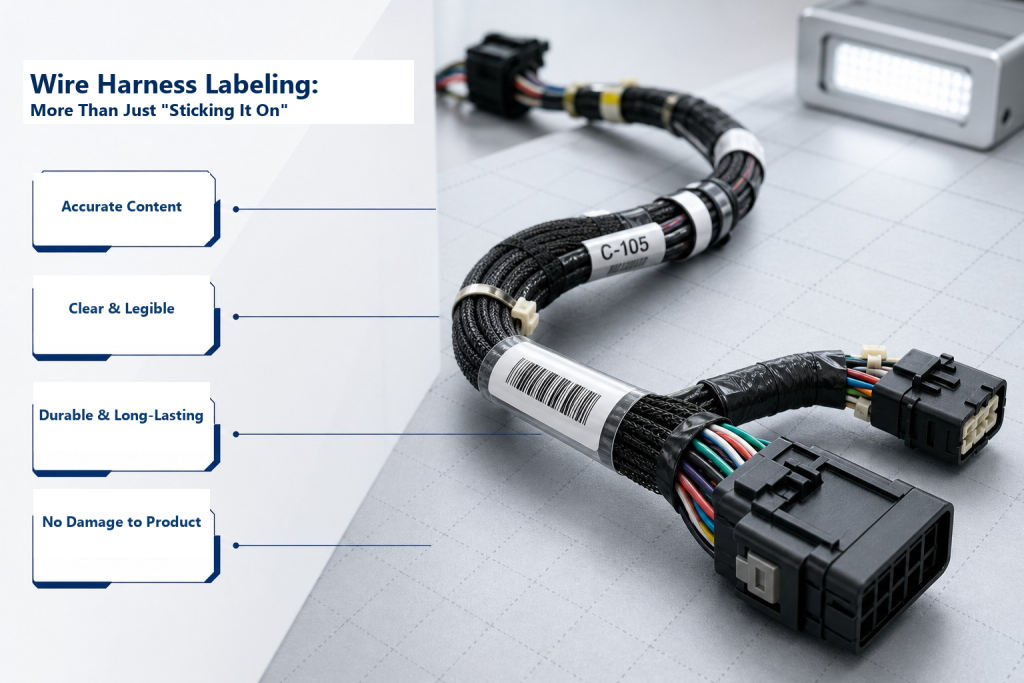
An incorrect label, a misplaced tag, or a marker that falls off in harsh operating environments can lead to miswiring during final assembly, costly field diagnostics, or complete equipment downtime.
Industry manufacturing standards (such as IPC/WHMA-A-620) group all manufacturer-applied tags, stamps, and wraps under “Marking.” The core engineering requirements can be distilled into four foundational rules: Accurate Content, Clear Legibility, Long-term Durability, and Zero Product Damage.
4 Critical Checkpoints for IPC-Compliant Wire Harness Labeling
1. Controlled Content: Strict Alignment with BOM & Drawings
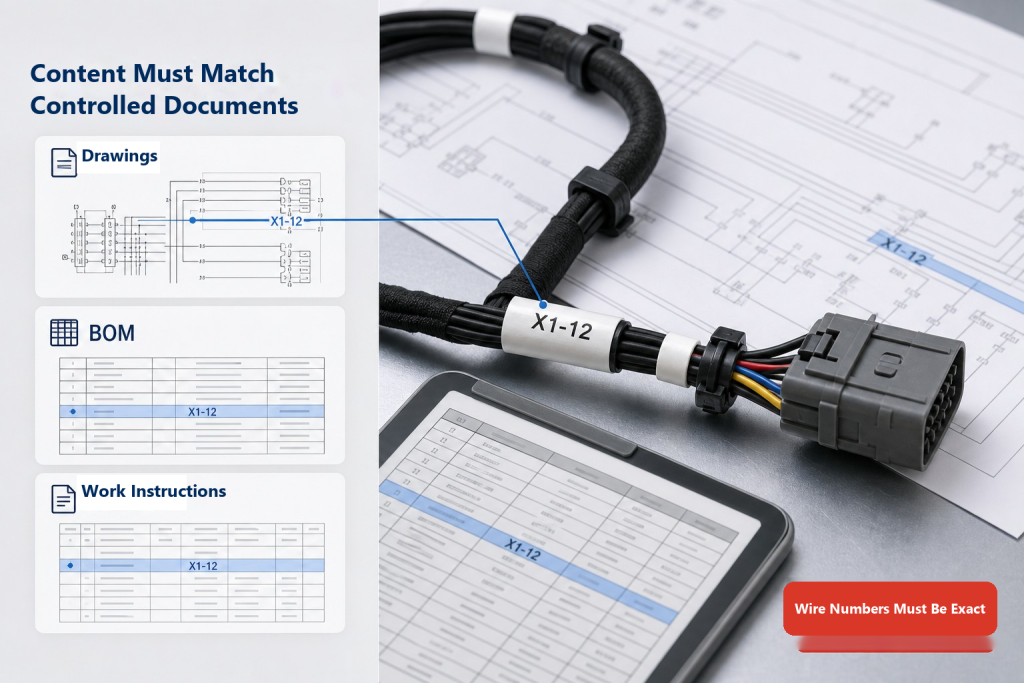
Marking content must strictly match the approved engineering drawings, Bill of Materials (BOM), work instructions, and customer specifications without missing characters. A single typo in a wire number, circuit ID, part number, color code, or barcode can cause an assembly technician to terminate a circuit into the wrong terminal or cavity.
- Internal Process Markers: Temporary manufacturing tags are permitted during sub-assembly, but they must never conflict with or obscure customer-specified markings.
- Delivery Requirements: Prior to shipment, non-permanent internal markers should be removed for Class 2 products and MUST be completely removed for Class 3 high-reliability applications.
2. Legibility: Readable by Human Eyes and Optical Scanners
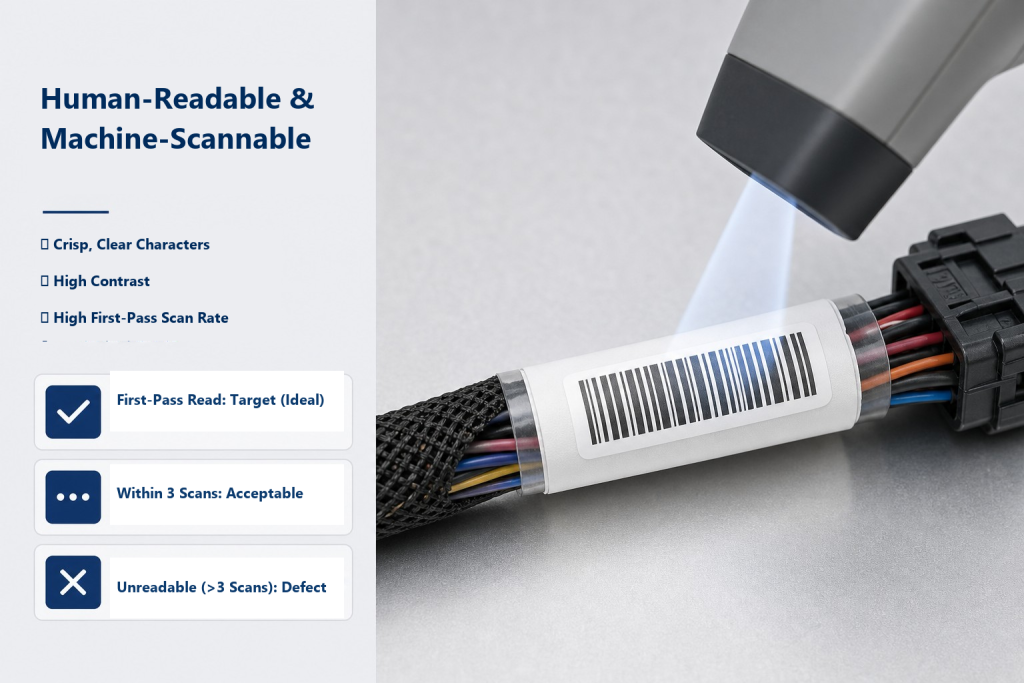
Proper wire harness markings must be readable under normal inspection lighting without high magnification, featuring uniform character height and sharp visual contrast against the background material. For 1D/2D machine-readable barcodes and QR codes, the scannability pass/fail criteria are strictly defined:
- Ideal State: Immediate recognition on the 1st scan.
- Acceptable Threshold: Successful scan within 3 attempts.
- Defect Criteria: Unreadable after 3 attempts (must be rejected as non-conforming).
Engineering Note: Barcode labeling is never just about “printing and sticking”—optical verification and scan rate testing must be integrated into end-of-line quality inspections.
3. Precision Placement: Zero Interference with Routing & Mating
When drawings specify exact label dimensions and locations, markings must be placed strictly according to print. When no location is specified:
- 300 mm Rule: For Class 2 and Class 3 harnesses, markers should be placed within 300 mm (12 inches) of wire breakouts, unterminated wire ends, or the rear accessory edge of connectors.
- Reading Direction: Marker orientation matters. Color-coded bands and sequential text must typically be read starting from the connector end outward to prevent misreading inverted numbers (e.g., “6” vs. “9”).
- Junction Clearance: For Class 3 assemblies, labels must never be placed directly over breakout tie-wraps or harness junction wraps, as this compromises bundling integrity and makes the label unreadable.
4. Insulation Integrity: High Durability Without Core Damage
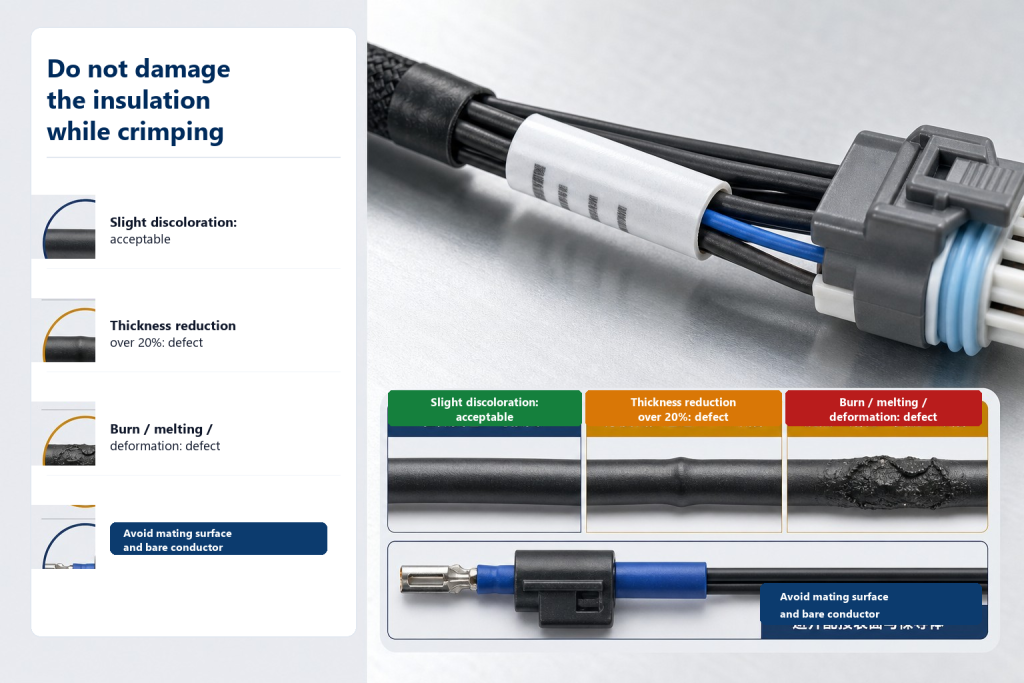
Whether utilizing thermal transfer printing, hot stamping, laser marking, or wrap-around sleeves, the marking process must never degrade the mechanical or electrical properties of the wire.
- Acceptable: Minor surface discoloration caused by hot stamping or laser printing.
- Defect Threshold: Any marking process that reduces the insulation wall thickness by more than 20%, or causes charring, melting, pinholes, or embrittlement of the jacket.
- Forbidden Zones: Markers must never be placed on active electrical mating surfaces, conductive fastener areas, or exposed bare conductors.
Inspection Guidelines for the Two Most Common Wire Markers
| Marker Type | Target & Optimal Standard | Minimum Acceptable Threshold | Defect Criteria |
| Wrap-Around / Self-Laminating Labels | Wrap 1.5 turns around the cable circumference for maximum adhesion. | Minimum 1.25 turns, firmly bonded with zero edge lifting. | Less than 1.25 turns, loose overlap, bubbling, or obscuring required text. |
| Tubular / Heat-Shrink Marker Sleeves | Fully recovered (shrunk) with tight fit; zero slippage along the wire axis. | Snug fit that holds position under normal assembly handling. | Splitting, cracking, loose sliding, or puncture holes exceeding 3 mm. |
Build-to-Print Custom Wire Harness Manufacturing with SHANYOU
A wire harness label is not an afterthought—it is a functional component of the product’s overall quality, safety, and traceability architecture.
With over 30 years of specialized manufacturing experience, SHANYOU Wire Harness is a premier OEM/ODM source factory dedicated to custom wire harnesses, industrial cable assemblies, and specialized equipment wiring.
- Standards Compliance: Complete in-house production adhering strictly to IPC/WHMA-A-620 workmanship standards and UL certification requirements.
- Full-Process In-House Production: From precision terminal crimping, soldering, and customized overmolding to specialized jacket assembly and automated wire marking.
- Extensive Material Options: Supporting multi-spec AWG wiring (UL rated, PVC, Teflon, Silicon, XLPE) and brand-name or equivalent connectors (Molex, TE, Deutsch, Amphenol, JST, etc.).
- 100% Quality Assurance: Every harness undergoes 100% electrical continuity testing, insulation resistance testing, and high-voltage (Hi-Pot) testing before packaging.
- Global Delivery Support: Reliable lead times and full export compliance for equipment manufacturers across North America, Europe, Southeast Asia, and the Middle East.